
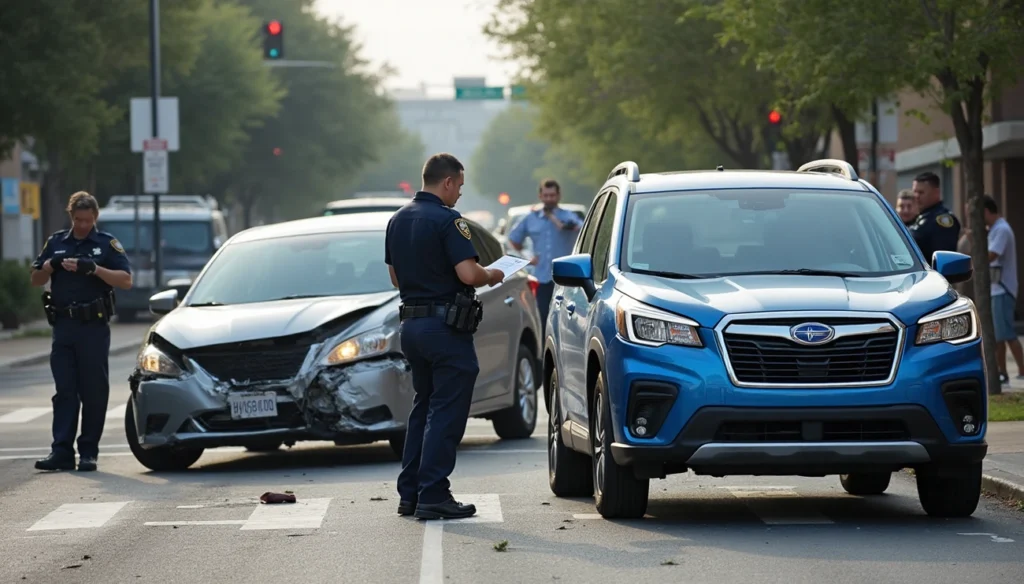
To dispute fault in a car accident claim, ask the insurer in writing for its fault decision and the evidence behind it, then send your own evidence and a short written account. Deadlines vary by state. In California, insurers generally must accept or deny a claim within 40 days of receiving proof of claim, per the state Department of Insurance.
This guide explains how fault decisions generally work and what you can do when you disagree. It is not legal advice. Fault rules, deadlines and the weight given to police reports differ from state to state, and a licensed attorney in your state can tell you how they apply to your crash.
Who decides fault after a crash?
Three groups weigh in, and they do different jobs.
Police officers may come to the scene, talk to drivers and witnesses, write a report and issue a ticket. A report is often important evidence, but in most claims it is not the final word on who pays.
Insurance adjusters make the decision that matters most for a claim. The California Department of Insurance notes that an insurer may take written or recorded statements, ask for an examination under oath, and contact the other drivers and witnesses. The insurer then decides who was at fault, and it may split fault between drivers.
Courts decide fault only when someone files a case that does not settle. State insurance regulators generally do not decide fault. The Texas Department of Insurance, for example, says it cannot decide who was at fault in an accident or determine damage amounts, although it can take complaints about how a claim was handled.
| Who | What they decide | How people usually push back |
|---|---|---|
| Police officer | What the report says and whether to write a ticket | Ask for factual corrections, add a statement, contest the ticket |
| Other driver’s insurer | Whether it pays your claim | A written dispute with evidence, then a supervisor review |
| Your own insurer | How it handles your claim and record | A written dispute, and a question about recovery from the other side |
| Judge or jury | Legal fault and damages | Through a lawsuit or small claims court |
Does your state use fault or no-fault rules?
The NAIC explains that each state uses either a tort system or a no-fault system. Under no-fault, your own insurer pays you directly for certain losses, and coverages vary by state. Because coverages and thresholds differ, your state insurance department can tell you which system applies and how fault affects claims where you live.
Why the fault decision costs real money
Fault decides which policy pays and what you pay out of pocket. The numbers below are illustrative. Say another driver hits you, your repair estimate is $5,000 and your collision deductible is $500.
| Fault finding | Who pays the $5,000 repair | Your out-of-pocket cost |
|---|---|---|
| Other driver at fault | Their property damage liability coverage | Often nothing |
| You at fault, with collision coverage | Your collision coverage | Your $500 deductible |
| You at fault, no collision coverage | No insurer | The full $5,000 |
If your own insurer pays first, it may try to recover that money from the at-fault driver’s insurer. If it succeeds, you may get your deductible back. Ask your adjuster in writing whether it is pursuing recovery.
The stakes rise when people are hurt. Texas requires at least $30,000 of coverage per person for injuries, per the Texas Department of Insurance, and California raised its minimum to $30,000 per person as policies renew starting January 1, 2025, per the California Department of Insurance. A serious injury can cost more than that, which is why a fault finding can matter beyond the repair bill. Our guide to how much car insurance you need covers limits.
What crash reports are required, and how do they differ from fault?
Reports to the DMV or police are about legal reporting duties and proof of insurance. They do not decide who caused the crash. California is one example of how these rules work.
- Under California DMV accident reporting rules, you must file an SR-1 within 10 days if anyone is injured, however minor, or killed, or if property damage is over $1,000. Your insurance agent, broker or legal representative can file it for you, and it is in addition to any police or insurance report.
- The California driver handbook says your driving privilege will be suspended for up to four years if you are in a collision without proper insurance, regardless of fault.
Other states set their own deadlines and forms, so check your state DMV’s site the week of the crash. File on time even while you dispute fault.
How long does an insurer have to respond?
There is no single national deadline. States set claims-handling standards. In California, the Department of Insurance summarizes the Fair Claims Settlement Practices Regulations this way: insurers must begin investigating within 15 days of notice of a claim, respond to your communications within 15 days, accept or deny within 40 days of proof of claim, and pay within 30 days of settlement. It also tells consumers to contact the department about unreasonable delays.
Your policy has its own rules on reporting a claim and cooperating with the investigation. Read the claims section and put any dates on a calendar. Ask the adjuster to confirm in writing any deadline that applies to you.
Where fault disputes tend to fall apart
Statements at the scene. The California Department of Insurance advises drivers not to sign statements about fault or promise to pay for the other party’s damages. Stick to facts when you talk to anyone.
A report error nobody fixed. Police departments set their own correction processes. Many will fix a plain factual error, such as a wrong plate number, while the officer’s opinion stays. Ask the records unit whether you can attach your own statement.
Missing evidence. Witnesses forget details and nearby cameras may record over footage within days. Start your proof file before the police report arrives. If you have a camera, our guide on whether dash cams are worth it covers how footage is used in claims.
Shared fault. Insurers can split blame, such as 70/30. How a split affects what you can collect depends on your state’s law, and those rules differ widely. In some states a share of fault reduces what you can recover, and in others even a small share can block recovery. A licensed attorney in your state can explain the rule where you live.
An uninsured driver. Proving the other driver was at fault may still leave no one to pay if that driver had no insurance. Your own uninsured motorist coverage, if you carry it, may be the path to payment.
Is every fault finding worth disputing?
Not always. The decision depends on the stakes and the evidence.
When a dispute is more likely to be worth the time
- Someone was hurt, or medical bills are coming.
- You have evidence the adjuster has not seen, such as video or a neutral witness.
- The repair cost is well above your deductible.
- You received a ticket you believe was wrong.
When it may not be
If the damage is minor, the bill is close to your deductible and you have no evidence beyond your own account, a long dispute may take weeks and end the same way. Ask your agent how a claim that size could affect your renewal before you decide. Our guide on why auto insurance goes up explains how claims feed into rates.
Where the money goes
Every fault dispute is a question of who pays. The other driver’s insurer has a financial reason to assign more of the blame to you, and your own insurer has one to recover what it paid. In 18 years of performance marketing in auto insurance, I have also seen how crash victims get marketed to. Some ads offering a free case review are lead forms run by marketing companies, not law firms, and your details can go to whoever buys the lead.
Before you fill out a form, check that the site names a real law firm and a lawyer licensed in your state. The CFPB suggests contacting a lawyer referral service through your state or local bar association and checking an attorney’s standing with the state bar before you hire.
Steps to dispute fault, in order
- Get the decision in writing. Ask for the fault finding, the reasons and the evidence relied on.
- Order the police report. Read every line, including the diagram and witness list.
- Correct factual errors. Contact the records unit and ask whether you can attach a written statement.
- Build a proof file. Gather photos of the scene and both cars, witness names and numbers, repair estimates, any video and, if you were hurt, your medical records.
- Send a short dispute letter. State what you disagree with and why, in the order events happened, attach your evidence, keep a copy and ask for a supervisor or claims manager review.
- Ask before paying a ticket. How a ticket affects a claim varies by state, so ask a licensed attorney in your state before you pay one you believe is wrong.
- Escalate if needed. File a complaint with your state insurance department, look up the insurer on the NAIC’s Consumer Insurance Search, and for injuries or large losses, talk to a licensed attorney.
What not to do
- Do not give a recorded statement to the other driver’s insurer before your notes are in order. You can ask to answer in writing.
- Do not post about the crash on social media.
- Do not sign a release or cash a check marked final until you know your full costs.
- Do not skip a DMV reporting deadline while you argue about fault.
If you are weighing legal help, our guide on whether you need a lawyer after a car accident walks through how people usually decide. In California, the State Bar lists certified lawyer referral services whose referred lawyers must be in good standing and carry professional liability insurance. Other state bars offer similar services.
Frequently asked questions
Can I change what a police report says about fault?
You usually cannot make an officer change an opinion. Many departments will correct factual errors and some let you attach your own statement, so ask the records unit about its process.
How long does an insurer have to decide my claim?
It depends on your state. In California, the Department of Insurance says insurers generally must accept or deny within 40 days of proof of claim and respond to your communications within 15 days.
Does my state insurance department decide who was at fault?
Generally no. The Texas Department of Insurance, for example, says it cannot decide fault or damage amounts, but it does take written complaints about how an insurer handled a claim.
What if both drivers are blamed?
Insurers can split fault, such as 50/50 or 80/20. How a split affects what you can collect depends on state law, which differs widely, so a licensed attorney in your state can explain your options.
Should I hire a lawyer just to dispute fault?
Many drivers handle a minor property damage dispute with a clear letter and good evidence. If someone was hurt or you face a lawsuit, talk to a licensed attorney, and your state or local bar’s lawyer referral service can help you find one.

Sources
- California Department of Insurance: Had an accident? What to do next
- Texas Department of Insurance: Auto insurance guide
- NAIC: Auto insurance consumer guide
- California Department of Insurance: New year means new changes for insurance
- California DMV: Accident reporting (SR-1)
- California DMV: Financial responsibility, insurance requirements and collisions
- CFPB: How can I find a lawyer?
- NAIC: Consumer Insurance Search
- State Bar of California: Certified lawyer referral services directory