
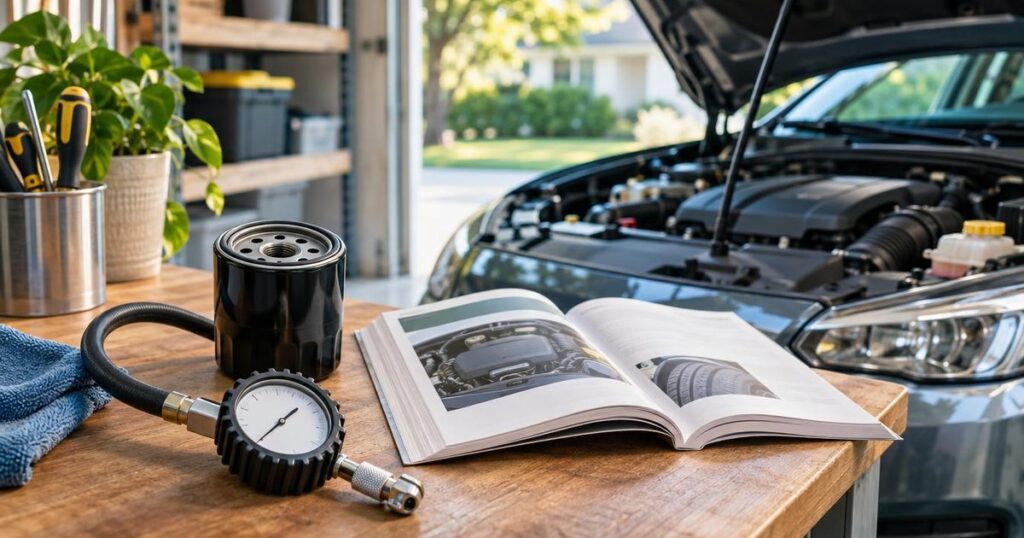
The maintenance habits that save the most are simple: follow your owner’s manual schedule instead of a shop’s menu, keep your tires at the pressure on the door label, and keep dated receipts so any qualified shop’s work counts for your warranty. That matters more since car repair prices rose 5.8% in the 12 months ended September 2026.
Over the same 12 months, the Bureau of Labor Statistics shows motor vehicle insurance prices down 5.0%. The service counter now deserves as much attention as your insurance renewal. Say you spent $800 on maintenance and repairs last year; if your costs rose in line with the national 5.8%, the same work would cost about $846 this year.
This guide covers what to do and when, which checks pay off, and how to tell maintenance from an upsell. For budgeting the bills that maintenance cannot prevent, see our guide to avoiding surprise car repair bills.
What counts as maintenance, and what is an upsell?
The lines on a service quote are not all the same kind of work. Sorting them into four groups makes a quote much easier to judge.
| Type of work | Who sets the timing | Proof to ask for |
|---|---|---|
| Scheduled maintenance, such as oil changes and rotations | Your owner’s manual, by miles or months | The manual page and your mileage |
| Wear items, such as brake pads and tires | How worn the part is | A measurement or a look at the part |
| Repairs, such as a failed water pump | A failure or a warning light | The trouble code or the failed part |
| Add-on services, such as extra flushes and treatments | Usually the shop | A written reason tied to your car |
Add-on services are the lines to question first. If an item is not on your manual’s schedule, ask what problem it fixes on your car and what the shop found that points to it.
Which maintenance checks pay off most?
Tires
Tires are the easiest place to save money and the easiest to neglect. NHTSA says to check the pressure of every tire, including the spare, at least once a month, when the tires are cold, meaning the car has not been driven for at least three hours.
- Use the right number. NHTSA says the correct pressure is on the tire and loading label on the driver’s door edge or in your owner’s manual, not the number molded on the tire.
- Watch the tread. NHTSA says tires are not safe once tread is worn to 2/32 of an inch. If you can see the top of Lincoln’s head in the penny test, it is time to replace them.
- Rotate if your maker says to. NHTSA suggests every 5,000 to 8,000 miles when the manufacturer recommends rotation. Some cars, such as those with different front and rear tire sizes, should not be rotated.
- Check the age. Some manufacturers recommend replacing tires that are six to 10 years old regardless of tread, according to NHTSA. The last four digits of the DOT code give the week and year the tire was made.
- Do not rely on the warning light alone. Cars from model year 2008 on must have a tire pressure monitoring system, but NHTSA says it only warns when a tire is significantly underinflated.
Pressure also affects fuel costs. The DOE and EPA fuel economy site says proper inflation improves gas mileage by 0.6% on average and up to 3%, and that mileage drops about 0.2% for every 1 psi of under-inflation. Say you spend $2,000 a year on gas and your tires run 5 psi low. That is about a 1% loss, or roughly $20 a year, fixed with a few minutes and a gauge.
Oil and filters
Use the oil grade your manual lists. The same fueleconomy.gov page says the recommended grade can improve mileage by 1% to 2%, and the wrong grade can cost about the same. If the manual calls for synthetic, use synthetic.
Engine air filters are a common upsell. The site says replacing a clogged air filter on a modern fuel-injected, computer-controlled engine does not improve fuel economy, though it can improve acceleration. Replace it on the schedule in your manual or when an inspection shows it is dirty, not to chase better mileage.
Battery, coolant, wipers and lights
NHTSA’s seasonal checklist suggests having a mechanic check the battery, charging system and belts, since cold weather reduces battery power. It also lists keeping enough coolant that meets the manufacturer’s specifications, checking for leaks, replacing worn wiper blades, keeping washer fluid full and checking every exterior light.
Warning lights and recalls
When the check engine light comes on, fueleconomy.gov says to have the car inspected by a mechanic, since the cause can range from a loose gas cap to a serious problem. Before paying for a repair, enter your 17-character VIN at NHTSA’s recall lookup. Recall repairs are free at a dealer.
Normal or severe schedule: which one is yours?
Many owner’s manuals list two schedules, normal and severe, and the severe one has shorter intervals. Your manual defines what counts as severe. It often includes short trips, towing, dusty roads and heavy stop-and-go traffic.
If your driving matches that list, the severe schedule is the right plan, and following it is not an upsell. If it does not, the normal schedule is the plan the carmaker built for your car. A shop that wants shorter intervals should explain what about your driving calls for them.
Sometimes the extra item is real. Grinding or squealing brakes, a soft pedal, or a car that pulls to one side when you brake are reasons to have the brakes checked promptly. For any wear item, ask for the measurement and ask to see the part.
Can where you get service affect your warranty?
The law is on your side here. The Federal Trade Commission says it is illegal for a dealer to deny warranty coverage just because routine maintenance or repairs were done somewhere else. Aftermarket or recycled parts do not void coverage unless they caused the damage, and the dealer has to show that they did.
The catch is paperwork. The FTC says the warranty company may ask for maintenance records, so keep receipts for oil changes, tire rotations, brake work and inspections, each with the date and mileage. Our guide to factory warranty vs. extended plans explains what the factory warranty covers.
Service contracts, often sold as extended warranties, can be stricter. The FTC says a contract may require you to follow the manufacturer’s maintenance schedule, and missing it might void coverage. Our guide to extended warranty exclusions and refunds shows which clauses to check.
How do you approve work without overpaying?
The FTC’s auto repair guide gives a short checklist that works for maintenance as well as repairs.
- Get a written estimate. It should list the problem, the parts and the expected labor, and say the shop will check with you before going past a set amount.
- Open your owner’s manual. Match each scheduled item to your current mileage, and question anything that is not on the schedule.
- Ask how labor is priced. Some shops charge a flat rate per job and others charge actual time worked.
- Ask for proof on wear items. Request the measurement and a look at the old part. Some states require shops to return replaced parts.
- Get a second opinion on big jobs. The FTC suggests one for expensive or complicated repairs.
- File the final repair order. The FTC says it should list each repair, the parts, the labor and the odometer reading.
In 18 years in finance and insurance performance marketing, I have watched ads lead with a cheap oil change or a free inspection. That low price is the hook, and the margin often comes from what gets added once the car is on the lift. A written estimate and your manual are the two best defenses.
Good records also help if you are weighing a service contract later. Our guide to whether an extended car warranty is worth it walks through that decision.
Frequently asked questions
Do I have to get oil changes at the dealer to keep my warranty?
No. The FTC says it is illegal for a dealer to deny warranty coverage because routine maintenance was done by someone else. Keep receipts that show the date and mileage so you can prove the work was done on time.
Which tire pressure should I use?
Use the pressure on the tire and loading label on the driver’s door edge or in your owner’s manual. NHTSA says the number on the tire itself is not the right target, and to check pressure monthly when the tires are cold.
How often should I rotate my tires?
Follow your owner’s manual. When the manufacturer recommends rotation, NHTSA suggests every 5,000 to 8,000 miles, or sooner if you see uneven wear. Some cars should not have their tires rotated.
Will a new engine air filter improve my gas mileage?
On a modern fuel-injected, computer-controlled engine, fueleconomy.gov says replacing a clogged air filter does not improve fuel economy, though it can improve acceleration. Replace it on your manual’s schedule or when it is dirty.
What should I do when the check engine light comes on?
Have the car inspected by a mechanic, as fueleconomy.gov advises, and ask for the trouble code and a written diagnosis before you approve a repair. Check your VIN for open recalls first, since recall repairs are free.